Welcome to the beauty renaissance, where your serum’s ethical resume gets as much scrutiny as its ingredient list. We’re not just buying products anymore; we’re casting votes with our wallets.
The numbers don’t lie. This conscious shift is fueling a market projected to hit a staggering $23.54 billion by 2030. What’s driving it? A potent mix of consumer awareness, personal values, and yes, some regulatory nudging.
In this landscape, badges from PETA or Leaping Bunny have become the trust-building gold standard. But let’s cut through the marketing haze. When one label shouts “vegan” and another whispers “cruelty-free,” are we speaking the same language?
Or is it more like comparing Kant to Kierkegaard—philosophically adjacent but fundamentally distinct? I’m here to unpack the jargon. We’ll separate the substance from the slogans.
Can your conscience really have its cake and not eat it too? Consider this your myth-busting, label-decoding session for the intellectually curious.
Definitions and Overlaps
Let’s clear up a common confusion: ‘cruelty-free’ and ‘vegan’ are not the same. Mixing them up leads to a maze of ethical shopping myths. You need a clear guide to navigate this world.
Cruelty-free means no animals were harmed in making the product. It’s about avoiding animal testing. But, a cruelty-free label doesn’t tell you what’s in the product. That fancy lipstick might be cruelty-free but could have beeswax or carmine.
Vegan means the product has no animal ingredients. It’s all about plant-based ingredients. Yet, a vegan product might have been tested on animals. The label checks the ingredients, not the testing history.
The best is when a product is both cruelty-free and vegan. This means no animal testing and no animal ingredients. To find such a product, look for both labels or a trusted certification.
Certifications help avoid confusion. Look for the Leaping Bunny logo or PETA’s “Beauty Without Bunnies” program. These badges prove the product’s claim, giving you peace of mind.
This table shows the difference and the best of both worlds. It’s your guide against common cruelty-free myths.
| Concept | Core Definition | What It Guarantees (And Doesn’t) | Recognized Certifications |
|---|---|---|---|
| Cruelty-Free | No animal testing at any product development stage. | Guarantees: Humane testing process. Does NOT guarantee: Absence of animal-derived ingredients (e.g., beeswax, collagen). |
Leaping Bunny, PETA’s Beauty Without Bunnies. |
| Vegan | Contains zero animal-derived ingredients or by-products. | Guarantees: Plant-based or synthetic formula. Does NOT guarantee: That the product or its ingredients were never tested on animals. |
Vegan Society Trademark, PETA’s Vegan logo. |
| The Overlap (Both) | A product that is both cruelty-free AND vegan. | Guarantees: Ethical process and ingredients. The ideal standard. Requires: Verification of both claims, often through dual certification. |
Brands certified by both Leaping Bunny and a vegan organization. |
There’s a big difference between cruelty-free and vegan. Knowing this helps you avoid false claims. It makes you a smarter shopper who can spot fake promises.
Understanding Vegan vs. Cruelty-Free
Imagine vegan beauty as what’s *in* the bottle, and cruelty-free as what *didn’t* happen before it got there. This isn’t just about words; it’s a big ethical question. Vegan beauty is about what’s in the product. Cruelty-free is about how it was made.
Vegan beauty means no animal products. No beeswax, no carmine, no lanolin. It’s a choice for the environment and your diet. You’re saying no to animal farming for your beauty products.
Cruelty-free means no animal testing. It’s a stand for animal rights. A product can be cruelty-free but not vegan. It can be vegan but tested on animals. This shows the difference.
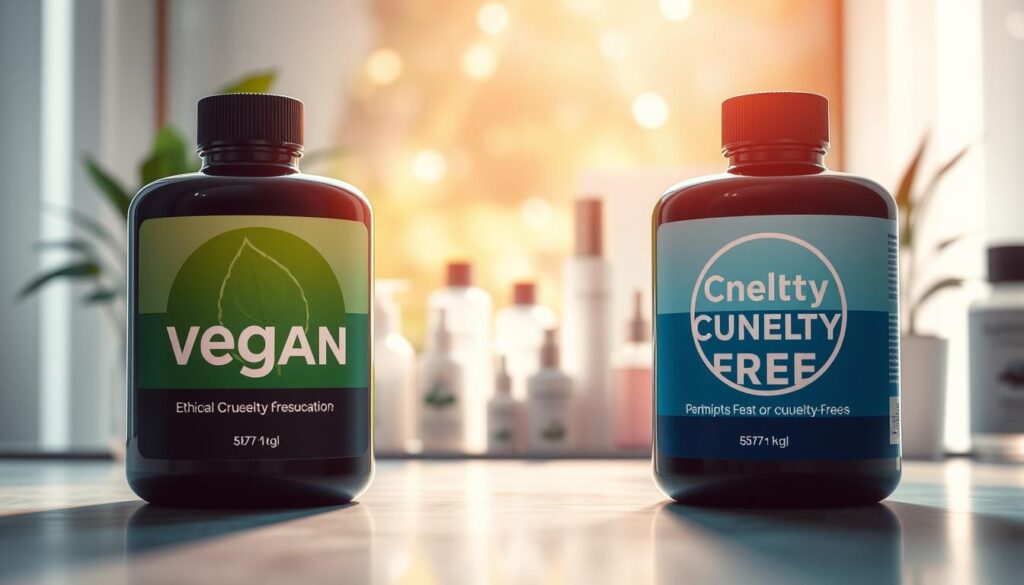
But here’s the twist. Vegan and cruelty-free are now working together. Consumers want both. They want products that are kind and plant-based.
Brands are listening. They’re making products that are both vegan and cruelty-free. This is what consumers want. They want to choose products that are good for animals and the planet.
Look at e.l.f. Cosmetics and Rare Beauty. They’ve grown by meeting this demand. The Body Shop went all in, making its entire line vegan in 2023. That’s a big statement.
When a brand is both vegan and cruelty-free, it answers two big questions:
- What am I putting on my skin? (Pure, plant-derived ingredients.)
- What suffering went into this? (Ideally, none.)
This isn’t just about labels. It’s about making informed choices. It turns you into a critical thinker. You see beyond the marketing and into the real ethics of your beauty products. That’s where real change starts.
Shopping Smart
Your wallet is your ballot in the beauty democracy. The candidates are masters of political spin. Moving from philosophical alignment to practical action requires more than good intentions—it demands strategic skepticism.
The first cruelty-free myths you’ll encounter aren’t in the fine print. They’re in the bold claims. “Not tested on animals” sounds definitive, right? Here’s the catch: it often refers only to the final product. Those individual ingredients? They might have quite the testing resume.
Then there’s the parent company paradox. A beloved indie brand proudly sports the Leaping Bunny. But its corporate owner? They test when required by law. Is your purchase funding the very practice you oppose? This gray area is where ethics get murky.
This is where demographic intelligence becomes your secret weapon. Data shows Millennials approach this like a research project. They value alignment, seek certifications, and reward transparency with fierce loyalty. Think of them as the investigative journalists of the beauty aisle.
Gen Z operates differently. Price and brand identity matter more, but so does social credibility. They use platforms like TikTok and Instagram to audit brands publicly. A vague claim in a bio? That’s an invitation for a comment-section interrogation.
So, which camp should you join? Be a hybrid. Channel the Millennial’s diligence: look for the third-party certifications. The Leaping Bunny and PETA’s logos aren’t just stickers; they’re audits. They mean a brand opened its books to scrutiny.
Then, embrace the Gen Z tactic: use your voice. Ask brands directly about parent company policies. Demand clarity on ingredient sourcing. Your public questions pressure them to be better. Transparency is no longer a bonus—it’s the price of entry.
Remember, every purchase is a market signal. When you choose a truly transparent, certified brand over a vague one, you’re not just buying moisturizer. You’re casting a vote for a specific kind of industry. You’re calling out the cruelty-free myths with your dollars.
The most powerful tool you have isn’t a magnifying glass for labels. It’s the understanding that beauty branding is a language designed to confuse. Smart shopping means learning to speak it fluently—and then rewriting the rules.
Label-Reading Tips
Reading a beauty label is like being a detective. You need to look closely for the truth. The pretty words about “botanical bliss” are just marketing. The real facts are hidden in small logos near the barcode.
For real vegan beauty and cruelty-free claims, look for symbols, not words. “Cruelty-free” is just a term, not a law. But, logos prove a brand’s promise.
Here’s your quick-reference guide to the major seals of approval:
- The Leaping Bunny: This is the non-negotiable seal for cruelty-free. It’s the gold standard because it requires a brand to open its entire global supply chain to independent audit. No third-party animal testing, anywhere, ever. It’s rigorous, international, and the closest thing to a guarantee.
- PETA’s “Beauty Without Bunnies” Logo: More common and easier to obtain. While PETA maintains a database, their ongoing verification process is considered less stringent than Leaping Bunny’s. It’s a good starting point, but not the final word.
- The Vegan Society Trademark (Sunflower Logo): Consider this the Harvard of vegan accreditation. A product with this logo contains zero animal-derived ingredients and is certified by the original vegan organization. It’s your definitive proof for vegan beauty.
See a brand sporting both the Leaping Bunny and the Vegan Society sunflower? That’s the ethical jackpot. Now, for the red flags. Words like “natural,” “green,” “conscious,” or “clean” floating without a certifying logo are merely aesthetic choices—decorative, not declarative. A brand claiming “we don’t test on animals” but lacking a logo might be telling a partial truth about their own facilities, while quietly outsourcing the dirty work.
Mastering label-reading is the art of trusting pixels over poetry. It transforms you from a passive consumer into an informed investigator. You’re no longer buying a story; you’re buying a substantiated ethic. Want to become a true pro at decoding beauty labels properly? It starts with knowing which symbols carry weight and which words are just weightless filler.
How to Avoid Marketing Traps
Dealing with beauty products’ ethical claims is tough. You need to be both skeptical and thorough to avoid greenwashing. This is when companies pretend to be eco-friendly but aren’t.
“Cruelty-free” and “clean” or “natural” are not the same thing. Just because something is natural, it doesn’t mean it’s safe. Some companies might say they’re cruelty-free but actually test on animals. If they don’t say they’re cruelty-free, it’s a red flag.
Rules for beauty products vary by country, making it hard to find a standard. This is where companies use marketing tricks. To stay safe, check the Leaping Bunny and PETA websites. They help you find real cruelty-free products.
Being an active consumer can really change things. By asking for clear information, you push companies to be better. Your choices have power. If a deal seems too good, it might not be.
The goal isn’t to find perfect products. It’s about making smart choices that help the industry become fairer. You don’t need a degree to know what’s right for your skin. Now you’re ready.