New Jersey’s proposed microplastics regulation could make ingredient disclosure more visible for some beauty products, but it is not law as of October 27, 2026. Assembly Bill A5452, named the Protecting Against Microplastics Act, was introduced on September 14, 2026 by Assemblywomen Shama A. Haider and Margie Donlon. The bill remained pending in the Assembly Environment and Solid Waste Committee as of October 27, 2026, and a Senate version, S4836, was introduced on October 15, 2026.
For beauty shoppers, the most useful way to read the proposal is as an ingredient transparency measure with staged disclosure, claim limits, and later restrictions if enacted. It would not tell an individual which products are medically appropriate for their skin or health history. People with personal health concerns, skin conditions, pregnancy-related questions, allergies, or medication considerations should discuss product choices with a clinician.
How Microplastics Regulation Would Change Labels
Microplastics Regulation Starts With Disclosure
The first practical change would be label disclosure. Under A5452, one year after enactment, covered products would need exterior product label disclosure about the presence of intentionally added microplastics or the potential for secondary microplastics. The bill defines microplastic as synthetic polymer material five millimeters or less in diameter, composed of synthetic polymers and chemical additives, and intentionally added during manufacturing or an industrial process; it also covers secondary microplastics or materials capable of generating them, according to the A5452 bill text.
That matters for cosmetics because ingredient names alone may not be easy for shoppers to interpret. A polymer-based ingredient can serve different functions in a finished product, and a consumer may not know from the ingredient list whether the proposal would classify it as intentionally added microplastic, a material capable of generating synthetic polymer microparticles, or outside the bill’s scope. A label disclosure would not replace full ingredient literacy, but it could make a specific regulatory concern easier to notice.
Label Space Exemptions May Limit Visibility
The bill also recognizes practical packaging limits. Labeling requirements would not apply to products too small to accommodate at least two square inches of labeling, or to items without an exterior container, wrapper, or tag. Products in which microplastics are present only in internal or electronic components would also be exempt from certain labeling requirements.
This is where shoppers should stay cautious. A missing disclosure would not always mean a product has no relevant polymer material. It may mean the item falls within an exemption, or that a requirement has not taken effect because the bill has not been enacted. Ingredient transparency depends on both legal requirements and how clearly brands choose to communicate beyond the minimum.
What The New Jersey Bill Covers
Cosmetics Sit Beside Other Product Categories
A5452 is broader than a traditional beauty law. Covered products include cleaning products, cosmetics, foodware, and potentially ingestible products. The research record for the bill lists examples that include chewing gum, tea bags, coffee grounds, talcum powder, pet food, and facial products. For the beauty category, that makes the proposal relevant to shoppers who track not only exfoliating particles but also polymer-based ingredients that may appear in facial, body, or powder products.
The bill would appropriate $3 million in total: $2.5 million to the Department of Environmental Protection for source reduction programs, research, monitoring, and testing, and $500,000 to the Department of Law and Public Safety for enforcement. The Department of Environmental Protection would also establish a source reduction program within one year of the effective date, monitor microplastics in environmental media such as air, water, soil, and biota, and submit a report no later than two years after the effective date, then annually after that.
| Timing If Enacted | Beauty-Relevant Requirement | Consumer Meaning |
|---|---|---|
| Year 1 after enactment | Disclosure on exterior labels for covered products | Some cosmetics could carry clearer microplastic-related information |
| Year 2 after enactment | Required statement for certain products and online listings; limits on microplastic-free claims | Claims may become easier to challenge if ingredients contradict them |
| Year 3 after enactment | Sales and distribution prohibition for covered products with intentionally added microplastics or materials that could generate secondary microplastics, with technically unavoidable trace amounts exempted | Some formulas may need reformulation or removal from sale in New Jersey |
In year two after enactment, certain products would need to state “This product contains microplastics” in both English and Spanish on handles or surfaces touching food or beverages, and in online listings. The bill would also ban “microplastic-free” claims for products that contain intentionally added microplastics. In year three after enactment, covered products containing intentionally added microplastics, or capable of generating synthetic polymer microparticles or secondary microplastics, would be prohibited from sale or distribution, except for technically unavoidable trace amounts.
How Beauty Brands May Need To Document Claims
The Proposal Goes Beyond Microbeads
New Jersey already enacted a narrower microbeads law in 2015. That law prohibited the manufacture of personal care products containing non-biodegradable microbeads starting January 1, 2018, and prohibited the sale of over-the-counter drugs containing microbeads starting January 1, 2020, as shown in P.L. 2015, c.028. A5452 would go further because it addresses intentionally added microplastics and materials capable of generating secondary microplastics across specified categories, not only non-biodegradable microbeads in personal care products.
For brands, the practical challenge would likely be documentation. A company making a “microplastic-free” statement would need confidence that the claim fits the bill’s definitions if it became law. Supplier information, ingredient function, polymer identity, and finished-product behavior could become more relevant to substantiation. The bill’s staged approach would give companies time after enactment, but the disclosure phase would arrive before the sales prohibition.
This connects closely with broader ingredient transparency in ethical beauty, where the central question is not whether a label sounds clean, but whether a claim can be checked against the formula and supporting records. A short front-label phrase can be helpful, yet it can also oversimplify if shoppers cannot see how the brand reached that conclusion.
Enforcement Would Carry Financial Risk
The research notes indicate that the New Jersey Division of Consumer Affairs would have authority to audit manufacturers, order stop-sales of noncompliant products, and notify the public of violations. Penalties described in the research include civil administrative fines from $1,000 to $20,000 per violation, with each day of noncompliance treated as a separate offense, and civil court fines up to $25,000 per day for certain violations.
For beauty companies, that structure would make microplastic-related claims more than a marketing issue. If the bill became law, a noncompliant claim or product could become a regulatory, retail, and reputational problem. For consumers, enforcement does not guarantee that every label will be easy to understand, but it can create pressure for brands to review formulas and disclosures with greater care.
What Shoppers Can Read Without Overreading
A Disclosure Is Not A Medical Instruction
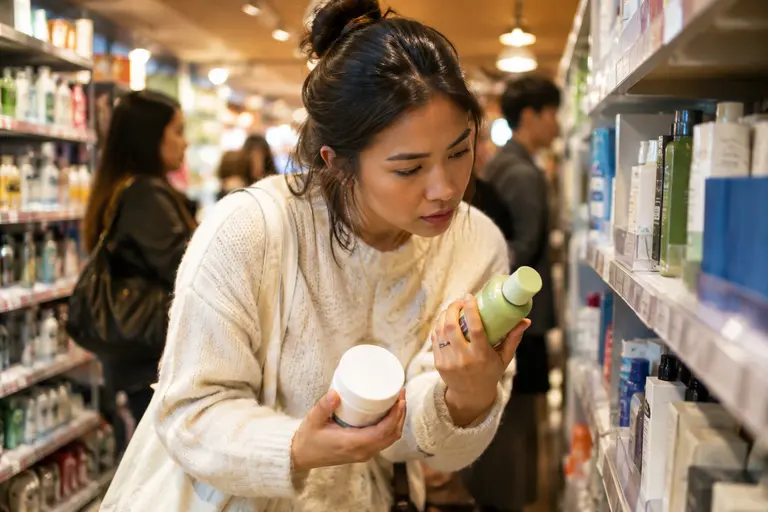
For beauty shoppers, microplastics regulation would be most useful as a signal about ingredient transparency and environmental policy, not as a personal health directive. A product disclosure about microplastics would not diagnose skin sensitivity, identify the cause of irritation, or determine whether a product is suitable for a person with eczema, acne, allergies, pregnancy, or a medical condition.
Labels can answer some questions: what a brand is required to disclose, whether a specific claim is being made, and whether a product falls into a covered category. Labels cannot fully answer how a person’s skin will respond, whether a formula interacts with a medical treatment, or whether a cosmetic choice is appropriate for a specific health situation. For broader consumer wellness education across related topics, Healthscope offers another reference point in the same publishing network.
Online Listings Would Matter Too
A5452 would not limit disclosure to physical packaging. Year two provisions would also apply to online listings for certain required statements. That point matters because beauty products are often compared online before purchase, and digital product pages can be where shoppers first encounter ingredient claims.
Still, shoppers should avoid reading silence as proof. If the bill has not become law, if a phase has not taken effect, or if an exemption applies, a product page may not carry the disclosure a consumer expects. A better approach is to compare the full ingredient list, brand claim language, and any microplastic-related disclosure together, then contact the brand when the information is unclear.
Microplastics Regulation And Beauty Questions
What To Ask Brands
A cautious reading of microplastics regulation starts with specific questions. If a brand uses a “free from microplastics” or similar claim, shoppers can ask how the company defines the phrase, whether the claim applies to the full finished product, and whether supplier data support it. If a product contains synthetic polymer ingredients, shoppers can ask whether those ingredients would fall within New Jersey’s proposed definitions if A5452 became law.
The strongest consumer position is not fear-based. It is evidence-based and label-aware. A5452 may create clearer disclosure duties if enacted, but as of October 27, 2026, it had not passed both chambers and had not become law. Until legal requirements change, voluntary brand transparency will still vary.
What To Discuss With A Clinician
If you are choosing cosmetics because of skin irritation, allergy concerns, pregnancy, a diagnosed skin condition, or a medication-related question, bring the product label or ingredient list to a clinician. Ask whether any ingredient category is relevant to your personal history, whether patch testing or referral to a dermatologist is appropriate, and how to evaluate symptoms without assuming one ingredient is the cause.
Microplastic disclosures can help shoppers ask better questions, but they do not replace individualized medical advice. For personal health decisions, consult a qualified clinician who can consider your health history, current products, and specific concerns.