
Yoga mortality research has drawn attention because several recent studies have linked yoga, Pilates, or flexibility-based activity with lower all-cause mortality risk. That does not mean a class can extend life on its own, or that every pose is safe for every person. The more careful reading is narrower: these practices may be markers of broader activity patterns, health status, access, consistency, and other lifestyle factors that researchers try to adjust for but cannot always fully separate.
The same caution applies across wellness choices, whether someone is comparing movement classes, skincare ingredients, or ethical product claims. A persuasive label is not the same as evidence. For yoga and Pilates, the strongest public message is not that one practice is superior, but that movement habits should be realistic, safe, and discussed with a clinician when age, pregnancy, surgery history, pain, eye conditions, balance issues, or chronic conditions are part of the picture.
What Yoga Mortality Research Shows
Yoga Mortality Research And Physical Activity Guidelines
One March 2026 analysis used National Health Interview Survey data from 2007, 2012, and 2017, including 26,055 adults and 815 deaths through 2019. It reported that people who met federal aerobic and muscle-strengthening activity guidelines and also practiced yoga had a 51% lower all-cause mortality risk than people who met those same activity guidelines without yoga, according to the PubMed record for the 2026 yoga study. The comparison matters: the study did not show that yoga replaced aerobic or strength activity. It examined yoga in relation to already meeting physical activity guidelines.
The same study reported that adults who did not meet physical activity guidelines and did not do yoga had a 77% higher mortality risk compared with adults who met the guidelines and did yoga. This finding supports a practical interpretation: yoga may fit best as part of a wider movement pattern rather than as a stand-alone substitute for aerobic and strengthening activity. Because the study was observational, it cannot prove that yoga caused the lower risk.
Why Associations Are Not Personal Predictions
Mortality studies often adjust for many factors, but adjustment is not the same as a randomized lifetime experiment. People who practice yoga may differ from non-practitioners in income, education, access to safe spaces, general activity, diet, sleep, smoking patterns, medical history, and health care use. Those factors can influence mortality risk on their own.
That is why yoga mortality research should be read as population-level evidence, not as an individual forecast. A person recovering from surgery, managing dizziness, or dealing with joint pain may need a different plan from someone who is younger, active, and already doing regular aerobic exercise. The safer wellness message is to ask what type of movement is appropriate, how intense it should be, and what modifications are needed.
Where Pilates Fits In The Evidence
Pilates Findings Need Careful Framing
A June 2026 U.S. nationally representative cohort study using National Health Interview Survey data from 2007 and 2012 included 55,023 adults and 5,530 deaths over about nine years. In that analysis, yoga was associated with a 27% lower all-cause mortality risk after adjustment, while Pilates was associated with a 36% lower risk. Those numbers are notable, but they remain associations from observational data.
For Pilates, the research base described here is thinner than the yoga evidence. That does not make Pilates unhelpful, and it does not make it a proven longevity practice. It means claims should be kept in proportion. Pilates often includes strength, control, mobility, and body awareness, but mortality studies do not isolate every class format, instructor style, intensity level, or participant background in a way that can answer every practical question.
What Flexibility Data Adds
A 2024 Korean prospective cohort followed 34,379 adults from baseline years 2007 to 2013 through the end of 2019. It found that flexibility physical activity performed at least five days per week was associated with lower all-cause mortality, with a hazard ratio of 0.80, as reported in the Korean cohort study. Because yoga commonly includes flexibility work, this finding offers useful context, but it does not prove that yoga itself was the reason for the association.
Flexibility-focused activity can also vary widely. Gentle stretching, yoga, Pilates, and mobility sessions are not interchangeable exposures in research terms. Duration, intensity, supervision, and participant health status can change the risk-benefit balance. This is one reason broad claims about “movement for longevity” need careful wording.
Common Myths About Yoga, Pilates, And Mortality
| Myth | What The Research Supports |
|---|---|
| Yoga or Pilates alone dramatically extends lifespan. | Recent studies show associations with lower risk, not proof that either practice directly causes longer life. |
| Meeting activity guidelines no longer matters if you practice yoga. | The March 2026 findings were strongest in people who met aerobic and strengthening guidelines and also practiced yoga. |
| More advanced poses are always better. | Adverse events have been reported, and risk may rise when vulnerable people attempt demanding postures or practices without suitable guidance. |
| Yoga always reduces falls in older adults. | A 2025-2026 program in older Australians reported more overall falls in an Iyengar yoga-based group than in a seated relaxation control, although injurious falls did not significantly differ. |
These myths tend to come from turning population findings into simple promises. That is a familiar problem in wellness marketing. The clearest evidence-based message is more modest: yoga and Pilates may be useful parts of a physically active life for some people, but they should not be promoted as shortcuts or risk-free practices.
Safety, Access, And Inclusive Wellness
Adverse Events Are Uncommon But Real
A July 2026 systematic review identified 84 adverse events tied to yoga across 70 case reports and case series. Most involved musculoskeletal injuries, followed by ophthalmological, neurological, and cardio-respiratory events. Older adults and people with preexisting conditions were overrepresented among moderate to serious events in that review. Case reports cannot estimate how common events are across all yoga participants, but they do show that “natural” or “gentle” does not mean risk-free.
Practical precautions are not dramatic: avoid forcing range of motion, be cautious with inversions or forceful breathing, tell instructors about relevant limitations, and stop movements that trigger concerning symptoms. People with medical conditions, recent procedures, pregnancy, balance concerns, eye pressure concerns, or unexplained pain should discuss activity plans with a clinician before changing routines.
Participation Depends On More Than Evidence
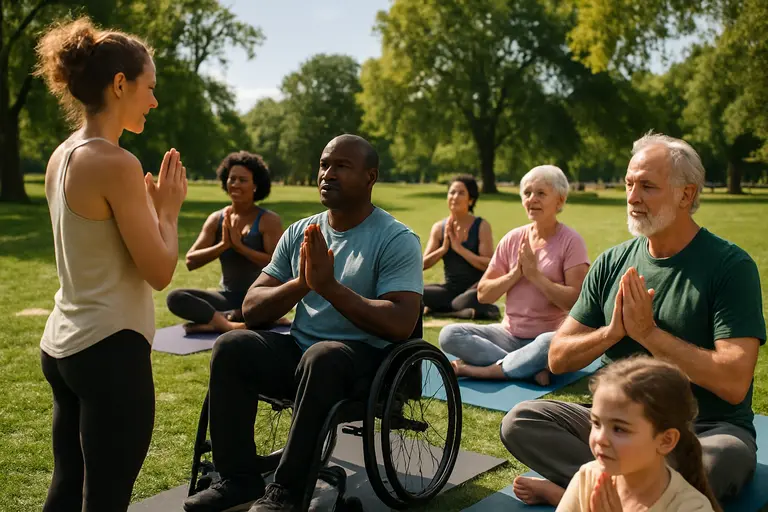
Access and comfort influence whether people can keep a movement habit. Class cost, transportation, language, cultural fit, body-size inclusion, disability access, and instructor training all matter. So does clothing comfort. Some people avoid classes because activewear feels exposing or distracting; related body-comfort resources such as the website cameltoe.org reflect how fit and garment design can affect confidence in movement settings.
Inclusive wellness programs should avoid shame-based messaging and should not imply that health is proven by flexibility, thinness, advanced postures, or expensive studio access. Ethical communication means being clear about uncertainty, offering modifications, and respecting different reasons people move: balance, stress management, strength, mobility, social connection, or simple enjoyment.
How To Read Yoga Mortality Research Carefully
Several patterns are worth keeping in mind. First, the newer evidence is more encouraging than older adjusted analyses that found yoga associations weakened after accounting for age and comorbidities. Second, even the encouraging findings are mainly observational. Third, Pilates results are interesting but should not be stretched beyond what the data can show. Fourth, safety findings remind readers that low-impact activity can still produce harm if the practice does not match the person.
- Ask whether a study measured yoga or Pilates directly, or whether it measured flexibility activity more broadly.
- Check whether participants already met aerobic and muscle-strengthening activity guidelines.
- Look for adjustment for age, health status, and lifestyle factors.
- Separate population-level risk estimates from personal medical decisions.
- Treat adverse event reports as safety signals, not as proof that everyone is at high risk.
This is also a useful standard for skincare and broader wellness claims: a product or practice can be appealing, ethical, or culturally meaningful without being a proven medical intervention. Evidence helps set expectations. It does not remove the need for individual judgment or professional guidance.
Yoga, Pilates, And Mortality Rates In Practice
The most useful reading of yoga mortality research is cautious but not dismissive. Yoga and Pilates may fit well within an active lifestyle, and some studies have linked them with lower all-cause mortality risk. The strongest interpretation is not that a weekly class guarantees a longer life, but that these practices may complement broader physical activity habits for some adults.
For personal decisions, discuss the details with a clinician or qualified health professional: whether yoga or Pilates is appropriate for your health status, whether you should modify inversions or balance work, how to combine flexibility with aerobic and strengthening activity, and what warning signs should prompt stopping or seeking care. That conversation is more reliable than any single headline about mortality rates.