Natural Clean Labels can make a product feel safer, kinder, or more ethical before you have read the ingredient list. The caution is that words such as natural, clean, green, eco, and non-toxic may sit beside incomplete disclosure or claims that do not match the finished product. For shoppers who care about cruelty-free and ethical beauty, the most useful approach is not cynicism. It is slower reading: what is being claimed, what is left unclear, and what kind of proof would make the claim meaningful?
Personal care shoppers often use label language as a shortcut. That is understandable. A moisturizer, body wash, serum, or cleanser can carry many claims in a small space, and the wording may combine skin comfort, environmental concern, sourcing, and animal welfare. Yet evidence from product testing and safety alerts suggests that marketing language is not always a reliable proxy for ingredient disclosure or product quality. For a wider understanding of consumer wellness, you can explore topics on a related site within the same network, like dailycalifornia.com.
Why Natural Clean Labels Need Evidence
Nontargeted Testing And Missing Ingredients
A study of 113 personal care and cleaning products using data collected by Million Marker reported that 98% of tested items contained at least one chemical not disclosed on the label. The same analysis reported that 85% had at least one chemical with known or suspected health hazards, including categories such as endocrine disruptors or carcinogens, even though many products used reassuring language such as natural or non-toxic, according to the ACS product analysis. Those findings do not mean every product with a clean or natural claim is harmful. They do show why a front label should not be treated as complete evidence.
The same study also found that among products labeled eco, green, or natural, 26% directly contradicted label claims by containing chemicals that labels said were excluded. That point matters for ethical beauty because a shopper may pay more, change routines, or avoid certain brands based on trust in claim wording. If a product says it excludes a substance, the basic expectation is that the finished product matches that promise.
Natural Clean Labels And Unlisted Chemicals
Natural Clean Labels may appear to simplify risk, but the research suggests the opposite problem: the label can become a partial story. A complete ingredient list is still central, yet even that list may not identify every detected chemical in a finished product. This creates a gap between consumer-facing language and what testing can find. For people with sensitive skin, allergies, pregnancy-related concerns, chronic conditions, or occupational exposure to many products, that gap may be worth discussing with a clinician rather than trying to solve by label reading alone.
Evidence also supports a more cautious interpretation of free-from claims. A free-from claim tells you only what a product says it leaves out. It does not confirm what replaces that ingredient, whether all fragrance-related substances are easy to identify, or whether the finished product has been independently checked. In ethical beauty, fewer ingredients can be easier to assess, but fewer words on the front of a bottle do not automatically mean clearer disclosure.
Where Clean, Natural, And Cruelty-Free Claims Split
Cruelty-Free Is A Different Claim
Cruelty-free language usually speaks to animal testing policies or certification rules. Natural and clean wording usually speaks to ingredient origin, excluded substances, or a brand-defined safety philosophy. These are related values, but they are not the same claim. A product could present itself as natural while leaving sourcing unclear. A product could be cruelty-free while still using broad fragrance wording. A product could use plant-derived ingredients while still raising questions about allergens, contaminants, or undisclosed compounds.
This distinction helps prevent ethical shopping from becoming a single-label decision. If animal welfare is the priority, the shopper needs evidence related to animal testing standards. If ingredient transparency is the priority, the shopper needs disclosure and support for safety-related wording. If sustainability is the priority, the shopper needs sourcing, packaging, and supply information. A single front-panel phrase rarely covers all of those concerns.
EU Alerts Show Natural Wording Has Limits
A review of European Safety Gate alerts from 2005 through 2023 found that 64% of cosmetics marketed or named in a way implying natural origin reported unauthorized ingredients, while 14% exceeded regulatory limits for substances. The review identified reported issues including synthetic fragrance ingredients such as butylphenyl methylpropional, dye concerns, heavy metals, and skin-bleaching chemicals in skin-lightening creams, as described in the Frontiers cosmetics review. This does not allow a direct judgment about every region or every brand, but it does support a clear lesson: natural wording is not a substitute for verification.
The skin-lightening example also shows why wellness writing should avoid fear and avoid promises. Some products raise concern because of specific ingredients, levels, or regulatory alerts, not because every product category is inherently unsafe. A careful routine focuses on the product in hand, the claim being made, and the evidence available. If irritation, discoloration, persistent itching, swelling, or other skin changes occur, a clinician or dermatologist can help assess what is happening.
Reading Natural Clean Labels With A Cautious Method
Start With The Full Ingredient List
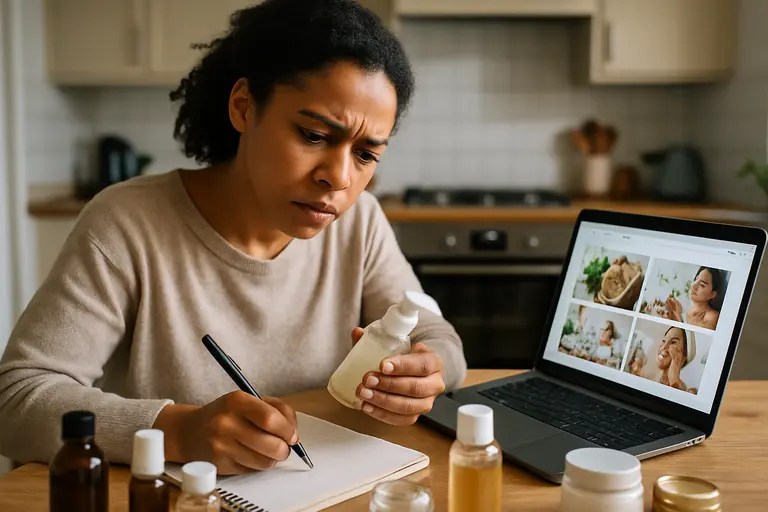
For Natural Clean Labels, start at the back of the package before accepting the front. The ingredient list can show whether the product relies on fragrance, botanical extracts, dyes, preservatives, or other ingredients you personally track. It can also reveal whether a brand’s clean positioning is specific or vague. A claim that names an excluded substance is easier to evaluate than a broad claim that simply says clean.
Shoppers can use a short, practical sequence:
- Separate claims by type. Identify whether the claim is about ingredients, animal testing, sourcing, environmental impact, or skin feel.
- Look for proof close to the claim. Stronger claims tend to define what is excluded, what standard is used, or what certification is being referenced.
- Be cautious with broad comfort words. Natural, clean, pure, eco, and green can sound reassuring without explaining testing or disclosure.
- Track personal reactions. If a product repeatedly causes discomfort, stop guessing from label language and speak with a qualified clinician.
Read Free-From Claims Narrowly
A product labeled paraben-free, sulfate-free, phthalate-free, fragrance-free, or non-toxic may still require careful reading. Free-from wording can be useful when it matches a personal need or preference, but it is narrow by design. It does not prove that the whole formula is better for every person, kinder to animals, or more transparent across the supply chain. For a deeper related discussion, the site’s article on ingredient transparency explains why disclosure gaps matter in ethical beauty decisions.
Price is not a reliable shortcut either. A higher price may reflect packaging, branding, ingredient sourcing, certification costs, or retail positioning. It may also reflect none of those in a way the shopper can verify. The more specific the claim, the easier it is to compare. The less specific the claim, the more the buyer is being asked to trust brand language.
Natural Clean Labels In Ethical Beauty
Questions To Bring To A Clinician
Natural Clean Labels are easiest to use when they are treated as prompts, not proof. A useful question is not simply whether a product is clean. Ask what the term means on that package, what the brand discloses, whether the claim relates to ingredients or animal testing, and whether any third-party standard is named. If the answers are hard to find, the label may be doing more marketing work than educational work.
For personal health decisions, especially if you have eczema, contact dermatitis, allergies, acne-prone skin, pregnancy-related concerns, a history of reactions, or use prescription skin treatments, consult a clinician or dermatologist. Helpful questions include: which ingredient categories should I watch for, whether patch testing is appropriate, how to interpret fragrance or botanical ingredients, and what to do if a product causes irritation. Ethical beauty can support more thoughtful buying, but personal skin care choices still need individual context.