
Adaptive Yoga is often discussed as a more inclusive way to approach movement, but the most useful question is practical: can a person participate with dignity, options, and clear support? A Guided by Humanity approach should mean that instruction begins with the person in front of the teacher, not with a fixed image of what a pose is supposed to look like. Because the research notes available here do not verify specific outcomes from an organization named Guided by Humanity, this article treats the phrase as a human-centered model for accessible wellness rather than as proof of program results.
That distinction matters. Accessibility in wellness should not depend on inspiring language alone. It needs class formats, props, communication, pacing, and safety boundaries that make participation more realistic for people with different physical abilities, chronic conditions, age-related changes, or mobility concerns. It also needs honesty: yoga instruction is not a substitute for medical care, rehabilitation, or individualized clinical advice.
What Adaptive Yoga Means In Practice
Adaptive Yoga modifies traditional yoga poses to accommodate people with diverse physical abilities and needs, including physical disabilities, chronic conditions, and age-related challenges, according to Healthline’s adaptive yoga overview. The goal is not to make every body fit one version of a pose. The goal is to make the practice responsive enough that more people can participate without being pushed beyond their capacity.
Adaptive Yoga Starts With Choice
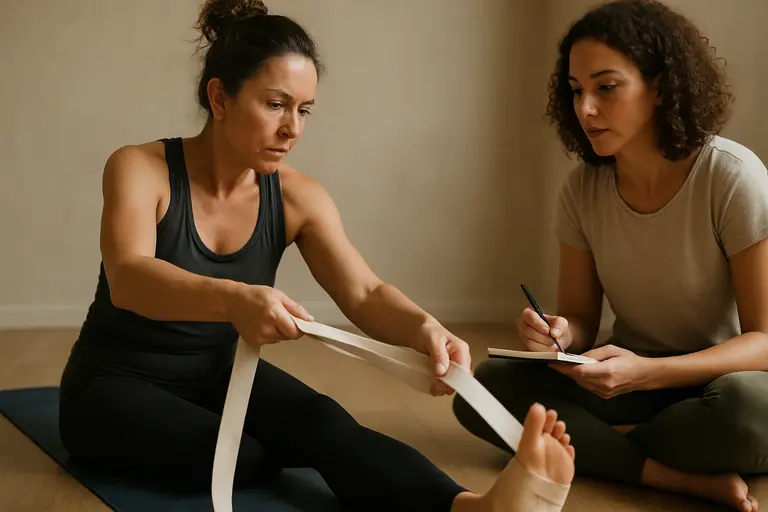
A class built around access usually offers more than one way to engage. A standing posture might become a chair-based movement. A floor pose might be practiced with a bolster, blanket, wall, strap, or caregiver support. A balance sequence might focus on stability and breath rather than range or appearance. These choices can reduce the pressure to perform and allow people to notice how movement feels in real time.
Choice also includes permission to pause. For someone living with fatigue, pain, dizziness, limited mobility, or changes in balance, rest is not a failure of participation. It is part of self-awareness. A well-led class should normalize breaks, explain options before they are needed, and avoid language that treats intensity as the main marker of progress.
Human-Centered Teaching Over Pose Perfection
The phrase Guided by Humanity points to a standard that wellness spaces can be measured against. Does the teacher ask about access needs without making assumptions? Are students given options privately and respectfully? Is the class space arranged so mobility devices, chairs, and support people are not treated as disruptions? These details can shape whether a participant feels welcome or simply accommodated after the fact.
From a cautious wellness perspective, the practice may support movement confidence, body awareness, and social connection for some people. Research summarized in the provided source notes that studies have examined balance, mobility, and quality-of-life outcomes for groups such as people with multiple sclerosis, Parkinson’s disease, and spinal cord injuries. Those findings should be read carefully. They do not mean every class is appropriate for every person, and they do not replace a clinician’s guidance for a specific condition.
Where Adaptive Yoga Fits In Community Wellness
Adaptive Yoga has moved from a smaller specialty offering toward wider public attention, with one industry-focused source describing its shift toward mainstream practice by 2026 due to demographic changes, more clinical interest, and a stronger cultural focus on inclusivity Yogajala’s accessibility report. The exact pace of that shift can vary by location, teacher training, studio budget, and community partnerships, so local access may still be uneven.
Access Is More Than A Chair Option
Chair-based movement can be valuable, but an inclusive program should not stop there. Accessibility can include clear registration forms, fragrance-aware spaces, captions for online classes, flexible camera expectations, easy-to-read instructions, and teachers who understand how to cue without shaming. It can also include class times that do not exclude people who need transportation support, caregiver coordination, or extra recovery time after appointments.
Time is a wellness factor as well. For individuals managing a busy life with disabilities or caregiving duties, fitting wellness routines into their schedule can be challenging. A thought-provoking article from Take Back Your Time emphasizes that access is not only about physical spaces but also about integrating wellness into daily life without additional stress.
Inclusive Wellness Requires Ingredient-Level Thinking
As someone who cares about skincare and ingredient knowledge, I see a useful parallel between beauty routines and movement spaces. A product label may sound natural, but a sensitive-skin user still needs to know the ingredients, fragrance, preservatives, and patch-test considerations. In the same way, a class may sound welcoming, but participants need to know the pace, equipment, teacher experience, room layout, and options for pain, fatigue, or mobility limits.
This is where broader conversations about inclusive wellness in health and beauty connect with movement practices. Ethical access means asking who is being centered, who is being priced out, who is being overlooked, and whether the offering is honest about its limits. A class should not promise outcomes it cannot guarantee.
How To Assess A Guided By Humanity Class
A human-centered class can be evaluated before anyone steps onto a mat. Clear information should be available in advance, especially for people who need to plan around mobility, sensory needs, pain patterns, medication timing, fatigue, or transportation. A teacher does not need to know every diagnosis, but they should be prepared to offer options and respect boundaries.
- Ask whether chairs, walls, blocks, straps, bolsters, or blankets are available and whether students may bring their own supports.
- Ask how the teacher handles pain, dizziness, fatigue, balance concerns, or the need to stop mid-class.
- Ask whether the space is accessible for mobility devices, service animals, or support people.
- Ask whether online classes include captions, clear audio, and options for students who prefer not to be on camera.
- Ask what training the instructor has in adaptive or accessible teaching, without assuming one certificate guarantees safety.
These questions are not meant to create barriers. They help clarify fit. A class can be warm and well-intentioned while still being a poor match for a person’s current needs. In wellness, kindness matters, but so does preparation.
Limits, Safety, And Evidence-Aware Expectations
No movement practice should be framed as a universal answer. People may have different needs based on age, joint stability, neurological symptoms, cardiovascular status, pregnancy, surgery history, medication effects, pain patterns, or balance concerns. Even gentle movement can be too much on some days, and a practice that feels supportive for one person may not suit another.
Benefits Should Be Discussed Carefully
Evidence discussed in the provided research suggests that adapted yoga formats have been studied for areas such as balance, mobility, and quality of life in certain populations. That is not the same as saying a class will treat a condition or produce a predictable result. The safer interpretation is that adapted movement may be one supportive option within a broader plan, depending on the person and the setting.
For beauty and wellness consumers, the same evidence-aware mindset applies across routines. Natural language, compassionate branding, and community stories can be meaningful, but they are not a substitute for transparency. People deserve to know what a class includes, what it does not include, and when professional medical input is needed.
Community Support Has Real Value
Accessible movement spaces can also reduce isolation by creating a place where varied bodies and abilities are expected, not treated as exceptions. That community aspect may be one reason the model resonates with people who have felt excluded from standard fitness settings. Still, social support should not be confused with clinical supervision. A yoga teacher and a healthcare professional have different roles.
Adaptive Yoga Questions To Discuss With A Clinician
Before joining an Adaptive Yoga class, consider discussing your plans with a clinician, physical therapist, or another qualified professional who understands your health history. Useful questions include whether any movements should be avoided, whether chair-based or floor-based practice is more suitable, how to respond to pain or dizziness, and whether balance support is recommended. If you are pregnant, recovering from surgery, managing a chronic condition, or taking medication that affects balance or blood pressure, personalized advice is especially valuable.
A Guided by Humanity approach is strongest when compassion and caution work together. Accessible wellness should give people more ways to participate, not more pressure to override their bodies. The best class for you is one that respects your limits, explains options clearly, and leaves room for clinical guidance when personal health decisions are involved.