
My journey into body care started with a panic in the drugstore. I was holding a stick of “clinical strength” deodorant. Its ingredients looked like a toxicologist’s list.
Aluminum was meant to block pores. Parabens and phthalates were for preserving. It felt like my body was under attack.
The usual approach sees sweat as a problem to fix, not a natural thing. It’s like trying to quiet a noisy neighborhood by paving it over.
Science says this method can mess with our skin’s delicate balance. This balance is key to managing our smell.
So, I decided to take a stand. I started making my own homemade deodorant. It’s not just about changing scents. It’s about taking back control of our bodies.
Understanding How Natural Deodorants Work
Your armpit isn’t a crime scene needing a lockdown. The antiperspirant industry has misled us about sweat. It’s just water leaving your body.
Sweat meets bacteria on your skin, creating a microscopic city. Sweat is like a buffet for bacteria. Body odor comes from bacteria breaking down sweat.
Traditional antiperspirants block sweat glands with aluminum. Natural deodorants take a different path. They manage the aftermath, not stopping sweat.
A natural deodorant recipe works in three ways:
- The Cleaning Crew: Coconut oil, tea tree oil, or witch hazel reduce bacteria. They keep the area clean without sterilizing it.
- The Absorbent Mats: Powders like arrowroot or cornstarch absorb moisture. This keeps your skin dry without blocking sweat glands.
- The Air Freshener: Essential oils provide a pleasant scent. They mask any remaining odor, making it enjoyable.
Natural deodorants don’t stop sweat because it’s good for you. Sweating helps regulate body temperature and remove toxins.
Switching to natural deodorant may preserve your scent signature. This is a remnant of evolutionary communication. Your unique odor is influenced by genetics, diet, and immune system.
The adjustment period can be challenging. Your underarm ecosystem needs to rebalance. For a week or two, you might smell more. This is detox and recalibration, not failure.
The goal is to achieve a clean baseline, not be odorless. You’ll smell like you after exercise, just not like a gym bag.
Understanding this science changes how we make deodorant. It’s not just mixing ingredients. It’s creating a tiny, benevolent government for your skin’s microscopic society. You’re the city planner, not the dictator.
Key Ingredients: Baking Soda, Arrowroot, Oils
Think of these ingredients as the founding fathers of your personal care revolution. Each plays a key role in controlling odor. Your aluminum-free deodorant DIY project depends on them. Let’s look at their roles with both science and humor.
Coconut oil is the charismatic CEO. It fights bacteria naturally, without harsh chemicals. It’s the base that holds everything together. Its unique property makes it easy to apply.
Shea butter is the compassionate HR department. It moisturizes and supports antibacterial efforts. It keeps your skin soft and prevents irritation.
Arrowroot powder is the efficient operations manager. It absorbs moisture without leaving a residue. It keeps you dry, letting other ingredients do their jobs.
Baking soda is the brilliant but controversial consultant. It’s great at neutralizing odor and soaking up moisture. But, it can be too much if not used right.
In my early DIY experiments, I used too much baking soda. I got a rash. This taught me the importance of moderation.
This experience is common in aluminum-free deodorant DIY. Baking soda is great in small amounts. But too much can cause irritation. The goal is to find the right balance.
Let’s break down their roles:
- Coconut Oil: Antibacterial base, texture controller
- Shea Butter: Moisturizer, skin protector
- Arrowroot Powder: Moisture absorber, texture refiner
- Baking Soda: Odor neutralizer, pH adjuster (use sparingly!)
Together, these ingredients work like conventional deodorants. Coconut oil fights bacteria. Shea butter soothes skin. Arrowroot manages moisture. Baking soda addresses odor. They form a complete system for underarm care.
Remember to balance these ingredients when making your own deodorant. Each has its own role. Disregard their roles, and you’ll face problems. Respect them, and you’ll enjoy peace and freshness.
This knowledge turns your aluminum-free deodorant DIY into a strategic process. You’re not just mixing ingredients. You’re building a team with special skills. Now that we know the players, let’s get started.
Basic Stick Deodorant Recipe
Let’s get hands-on in the kitchen, turning it into a lab. We’ll use measuring spoons as our tools. It’s not just about following a recipe. It’s about knowing why each ingredient is there.
We have two main recipes for your first homemade deodorant. They’re like two different teams working towards the same goal: keeping you fresh. The first is the “luxury model,” rich with butter. The second is the “minimalist edition,” simpler with oils. Choose based on your skin and what you have at home.
| Ingredient | Luxury Model Recipe | Minimalist Edition Recipe |
|---|---|---|
| Coconut Oil | 2.5 tablespoons | 1/3 cup |
| Shea Butter | 2.5 tablespoons | — |
| Arrowroot Powder | 1/4 cup | 1/4 cup |
| Baking Soda | 1.5 tablespoons | 1/4 cup |
| Essential Oils | 10-15 drops | 10-15 drops |
The luxury model is great for dry skin, feeling rich and moisturizing. The minimalist version is straightforward, focusing on function. Both are effective natural deodorants that outdo commercial products.
First, mix the coconut oil and shea butter in a double boiler. This method melts them into a single liquid. It’s called “liquid democracy.”
After heating, remove the bowl from the heat. This step is key. Now, add the dry ingredients—arrowroot and baking soda. You’re mixing more than just ingredients; you’re creating a chemical bond.
Lastly, add your essential oils. Heat can damage their delicate compounds. Stir until it’s a smooth paste. Pour it into your chosen container, like a small glass jar.
Now, wait for it to cool. This isn’t just cooling down. It’s the coconut oil solidifying, holding everything together into a firm paste.
The minimalist recipe is simpler. Just mix the coconut oil with baking soda and arrowroot powder. Add essential oils and store it in a jar. It’s quicker but has a grainier texture.
Why use a double boiler for one recipe but not the other? Shea butter is hard to melt without burning. Coconut oil, on the other hand, softens easily at room temperature.
Every ingredient plays a role in this DIY deodorant. Baking soda is alkaline, but too much can irritate. Arrowroot balances it. The oils and butters deliver the active ingredients to your skin.
Your first batch is an experiment. Check how it feels. Is it smooth or too hard or soft? The beauty of a homemade deodorant recipe is that you can customize everything.
This process makes self-care clear. You’re not just making a product. You’re creating a solution based on understanding, not marketing. That’s the real power of becoming a creator.
Sensitive Skin Formulations
Think of sensitive skin as the most delicate part of your body. It needs careful solutions, not broad policies. For some, baking soda is too harsh.
The main problem is pH. Your skin likes a slightly acidic environment. Baking soda is alkaline. This can cause redness, itching, and “the baking soda rash.”
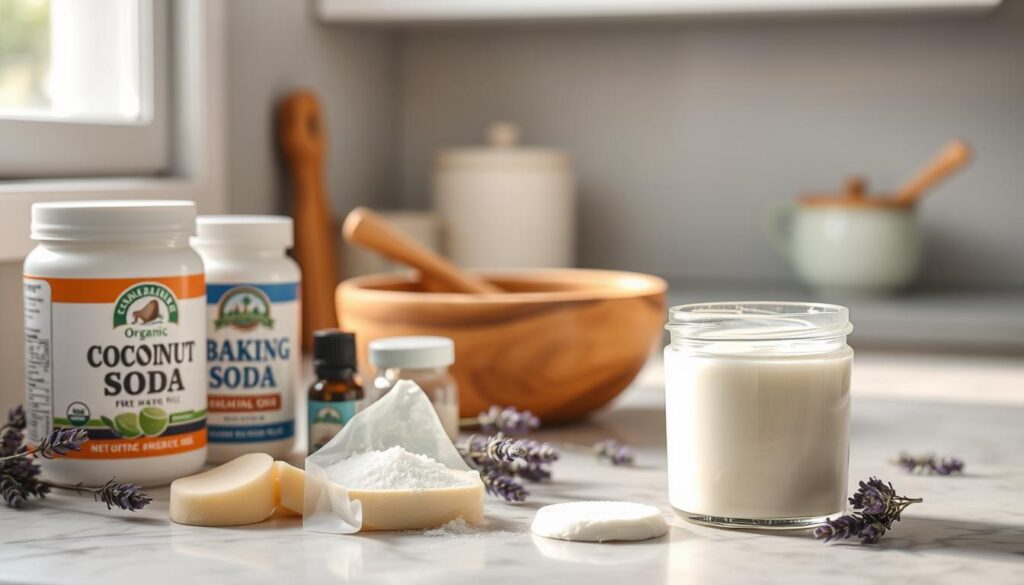
To find peace, we have two main strategies. First, we can use less baking soda. Sometimes, a small amount is enough for odor control.
The second option is to replace baking soda with magnesium hydroxide. This gentler agent does the same job without irritation. It’s a welcome change for your skin.
Timing is also key. Applying deodorant too soon after shaving is like negotiating during a fight. Always wait at least six hours.
We also need to watch out for volatile ingredients. Tea tree oil is powerful but can irritate sensitive skin. It’s often left out of sensitive skin formulas.
| Ingredient/Factor | Basic Formula | Sensitive Skin Adaptation |
|---|---|---|
| Baking Soda Role | Primary odor-neutralizing agent, standard amount | Either drastically reduced or replaced with magnesium hydroxide |
| Application Timing | Can be applied anytime | Wait 6+ hours after shaving to avoid irritation |
| Tea Tree Oil | Often included for antibacterial power | Frequently omitted to prevent possible reactions |
| pH Impact | More alkaline, can disrupt skin’s acid mantle | More balanced, designed to be gentler on skin pH |
| Primary Goal | Effective odor and wetness control | Effective control without causing redness or rash |
Making a natural deodorant recipe for sensitive skin is smart, not weak. It’s about creating a better constitution for your skin.
The idea of one-size-fits-all in body care is a myth. Your formula should respect your skin’s unique needs. The goal is to stop odor and keep your skin calm.
Cream and Paste Deodorant Options
The stick deodorant is like a smartphone in personal care—it’s sleek and convenient. But, what if you prefer the feel of a well-balanced chef’s knife? The cream and paste deodorants offer that tactile experience. They are a choice for those who value utility and beauty.
This type of deodorant is like a small-batch, artisanal product. It comes in a jar, avoiding the need for fancy plastic packaging. You use your fingers to apply it, controlling the amount and pressure.
Warming the paste in your fingers is calming. It connects you directly to what you’re applying. This method is simple, effective, and satisfying.
Choosing a jar over a tube has many benefits. First, mixing ingredients is easier, creating a consistent paste. Second, there’s no risk of the formula separating like in a stick. Lastly, you have full control over how much you apply.
With a jar, you can adjust the amount based on your needs. Need more under one arm? Just add a bit. It’s all about personal control.
| Feature | Cream & Paste (Jar) | Solid Stick (Tube) |
|---|---|---|
| Application Method | Fingers. Tactile, warm, customizable. | Twist-up mechanism. Hands-off, consistent. |
| Ingredient Stability | Excellent. Less prone to separation. | Can be prone to “sweating” or cracking. |
| Customization | High. Adjust amount and placement easily. | Low. Fixed amount per swipe. |
| Container | Glass jar. Zero-waste, reusable. | Plastic tube. Often single-use. |
| Sensory Experience | Engaging, connected, almost ritualistic. | Efficient, clean, and detached. |
Using a jar is like moving from pre-packaged meals to cooking from scratch. It makes your aluminum-free deodorant DIY project simpler and more elegant. It removes complexity, not adds it.
Creating deodorant is more than just making a product. It’s about crafting a tool. And sometimes, the best tool is one you use with your own hands.
Natural Antibacterial Agents
Managing odors is more about controlling populations than hiding smells. Your homemade deodorant acts as a skin microbiome intelligence agency. It’s about diplomacy, not war. You’re shaping the environment, not attacking it.

Every good plan needs special agents. Let’s look at the key players in your odor-control team.
Coconut oil is your top field agent. It uses lauric acid to attack bacteria from the inside. This acid breaks down bacterial walls, effectively stopping their operations.
Shea butter is the support team. It’s all about creating a safe environment for other agents. It helps keep your skin healthy and balanced.
Tea tree oil is the special forces unit. It’s a precise tool for fighting odor-causing bacteria. But use it carefully to avoid harming your skin.
Other essential oils are also important. Lemon and grapefruit oils clean and freshen. They help understand and manage your skin’s signals.
Bacteria aren’t the enemy; they’re just residents. Your goal is to find a balance. A good natural deodorant keeps bacteria in check without harming your skin’s health.
Each ingredient has a specific role. Coconut oil disrupts bacteria, tea tree oil attacks them, and shea butter keeps things stable. The key is to use them wisely.
When making your own deodorant, think of it as a strategy session. Each ingredient has a role in controlling odors. The goal is to find a balance that works without being harsh.
Using homemade deodorant is like managing a complex ecosystem. Your underarm is a delicate area, and your deodorant is the envoy that keeps it balanced and odor-free.
Scenting with Essential Oils
Scenting your homemade deodorant is not just about covering smells. It’s about creating a unique scent for your personal care. Essential oils are special compounds with health benefits, not just fragrances.
Lavender is like a calm leader in your collection. Grapefruit is the energizing motivator. Peppermint is the fresh reformer. Each oil adds its own special touch to your natural deodorant recipe.
Some oil combinations are like political alliances. Lavender and Tea Tree form a strong team. They balance calm and fight bacteria well. Lemongrass brings a citrusy, fresh vibe.
Choosing your oils is like picking a personal brand. But remember, the scent should match the function. It’s about real benefits, not just smell.
| Essential Oil Combination | Aromatic Profile | Therapeutic Benefits |
|---|---|---|
| Lavender + Tea Tree | Herbal, medicinal, clean | Calming, strong antibacterial, skin-soothing |
| Grapefruit + Lavender | Citrus bright with floral depth | Uplifting, mild antibacterial, mood-enhancing |
| Peppermint Solo | Crisp, cooling, invigorating | Antimicrobial, cooling sensation, respiratory support |
| Lemongrass + Palmarosa | Grassy, floral, slightly sweet | Antifungal, deodorizing, stress-reducing |
These oil mixes offer different approaches for your underarms. The Lavender-Tea Tree mix covers all bases. The Grapefruit-Lavender combo boosts your mood.
Creating your unique scent is all about trying new things. Start with 15-20 drops per batch. Keep track of your mix like a political strategist. The mix of top and base notes is key.
For more advanced scents, check out our guide to DIY scented deodorant. It’s like a masterclass in making scents.
Your natural deodorant recipe should match your smell preferences and needs. The oils you pick are part of your daily routine. They’re more than just a scent—they’re your personal policy.
Troubleshooting Common Issues
Every DIY project has its post-launch audit. Your aluminum-free deodorant DIY is no different. Consider this your strategic debrief.
The first hiccup is often the adjustment period. Your underarm microbiome is holding new elections. Give it a week or two to establish a new, odor-fighting coalition. Patience is the policy here.
A skin rash is a common rebellion. Baking soda, while effective, can wage a pH war on sensitive skin. The solution is a diplomatic reduction of troops or a full replacement with a gentler ally like magnesium hydroxide. Always apply your creation to calm skin, never immediately after shaving.
If your deodorant refuses to solidify, you likely have a cabinet disagreement. Fractionated coconut oil stays liquid. For a firm stick, use regular coconut oil and consider a brief stint in the refrigerator. It’s a simple cooling-off period.
Staining on clothing is a possible side-effect of the oils. The hot water trick is your diplomatic solution—running hot water through the fabric’s inside often dissolves the mark before it sets.
Your aluminum-free deodorant DIY might require more frequent reapplication than commercial brands. It’s not a failure of government, just a different political system. Carry a small tin for midday touch-ups.
Each solved problem deepens your understanding. This troubleshooting turns a simple recipe into a personalized, effective formula. You’re not just making deodorant; you’re engineering a solution.