
That world of making beauty products at home is everywhere online. It looks easy: everyone can formulate. But before you start mixing things, there’s important stuff to know.
The U.S. Food and Drug Administration is like a referee. They make sure you follow the rules. Laws like the FD&C Act and the new MoCRA mean you’re responsible.
So, what does this mean for your homemade beauty safety? You have to prove your products are safe. Making something bad isn’t just a mistake—it’s a big problem.
This isn’t about stopping you from being creative. It’s about being honest. These guidelines help you avoid trouble. They keep you safe from becoming a cautionary tale online.
Importance of Patch Testing
Before you use that homemade serum, think about this: your skin might not agree. It’s not just a small disagreement. It could lead to redness, swelling, and the urge to find urgent care.
Patch testing is like a mini experiment in your bathroom. It helps you see if your skin likes lavender essential oil or not. It’s not about being paranoid. It’s about knowing your skin’s needs.
My kid is my skin sensitivity barometer. He shows reactions first and loudly. This has taught me to be careful with products.
Why is this important for your DIY projects? Skin reactions to ingredients are real. Your skin can react differently over time.
The process is simple but essential:
- Where: Use the inner forearm or behind the ear
- How: Apply a small amount of your product
- When: Wait 24-48 hours without washing
- What to watch for: Look for redness, itching, swelling, or texture changes
Think of it as a small clinical trial. You’re the researcher, and your skin is the test subject. Would you approve a drug without testing it first? Exactly.
Essential oils and natural preservatives need extra care. Bergamot oil might smell nice but can cause skin problems in sunlight. Some plants can cause reactions over time.
| Test Location | Sensitivity Level | Visibility | Recommended For |
|---|---|---|---|
| Inner Forearm | Medium-High | Easy to monitor | Most products, daytime testing |
| Behind Ear | High | Discreet | Fragrances, hair products |
| Back of Neck | Medium | Less visible | Overnight testing |
The 24-48 hour wait is important. Immediate reactions are obvious. Delayed reactions are subtle but just as important.
Skipping this step is risky. It’s like doing human trials without permission. The results can range from mild irritation to serious skin problems.
This approach makes natural cosmetics safety a daily habit. It shows that “natural” doesn’t always mean safe for everyone. Poison ivy and arsenic are natural but not safe for everyone.
Think of patch testing as your skincare Bill of Rights. It sets boundaries and protects against unexpected reactions. The wait might be hard, but it’s better than dealing with skin problems later.
Sanitization and Clean Workspace Setup
Your goal is to make a serum, not grow bacteria on your counter. Your kitchen is full of microbes. Every spice jar and dish towel is a risk to your aloe gel.
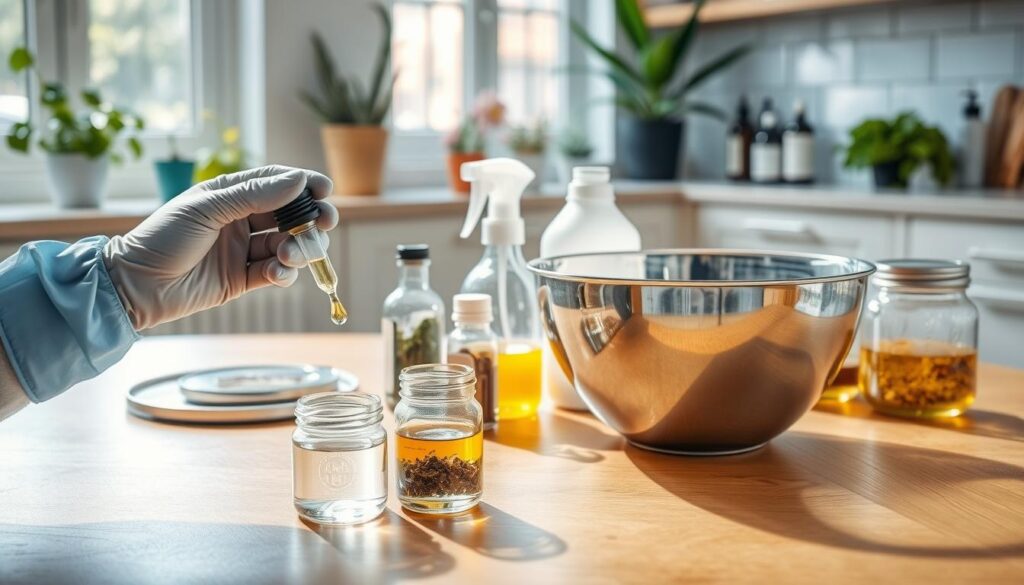
This isn’t about making your space as clean as a lab. It’s about following basic Good Manufacturing Practice (GMP). This means keeping your space clean and organized. It’s like declaring a truce with mess.
Start by cleaning every surface with a disinfectant. Then, use 70% isopropyl alcohol to sanitize tools and containers. This alcohol level is best because it kills microbes without evaporating too fast.
Remember, you’re part of the workspace too. Wash your hands like a surgeon. Wear gloves to keep your product clean. And tie up long hair to avoid any stray hairs becoming a problem.
Here’s what you need to do before you start:
- Sanitize all surfaces with a disinfectant spray or wipe.
- Immerse tools and containers in or wipe with 70% isopropyl alcohol and let them air dry.
- Wash and dry hands thoroughly, then don disposable gloves.
- Remove loose items (jewelry, watches) and secure hair.
- Use only clean, dedicated utensils—no double-dipping with cooking spoons.
This might seem like a lot. But it’s essential. Skipping these steps means risking contamination. A clean workspace is key to making a good product. It turns your kitchen into a place for making lotion, not a science experiment gone wrong.
Measuring and Mixing Safety Protocols
When you start making beauty products at home, you leave the kitchen world behind. Cooking is all about feeling and instinct. But making beauty products is a science that needs exactness.
Your most important tool is a digital scale that can measure to 0.01 grams. It’s like a magic wand that keeps your creations safe and effective.
Using a scale instead of measuring by volume is key. A “drop” of essential oil can change depending on the oil’s density and temperature. This small difference can make a big difference in your product’s quality.
Being precise is not just for safety. It’s also for your sanity. Writing recipes in percentages makes them easy to reproduce. This way, your homemade products will always work the same way.
Let’s look at why measuring by weight is better than volume. The table below shows the difference clearly.
| Ingredient Type | The “Volume” Method (The Guess) | The “Weight” Method (The Protocol) | Risk of Inaccuracy |
|---|---|---|---|
| Essential Oils (e.g., Lavender) | Measuring by drops from a bottle. | Measuring by grams on a 0.01g scale. | Extremely High. Viscosity and temperature cause huge variance. A 20% overdose is easy. |
| Active Powders (e.g., Vitamin C, Clays) | Using measuring spoons (tsp, tbsp). | Taring your container and weighing in grams. | High. Packing density makes a “heaping” spoonful a dangerous unknown. |
| Liquid Carriers (e.g., Jojoba Oil) | Using fluid ounce measuring cups. | Weighing in grams (1ml ≈ 0.9-1g depending on oil). | Moderate. Better than powders, but temperature affects volume. Weight is constant. |
| Water Phase (e.g., Aloe Vera Juice) | Using a liquid measuring cup. | Weighing in grams for perfect percentage accuracy. | Low for water, but critical for recipe math. Ensures your preservative system is correctly calculated. |
Using tap water in your beauty products is not a good idea. It has minerals, chlorine, and bacteria. This can ruin your products and cause irritation.
Distilled water is the best choice. It’s clean and doesn’t add anything to your products. This keeps your beauty products stable and effective.
So, use a scale, write recipes in percentages, and choose distilled water. This way, you can make beauty products that are safe and work well. Your skin will thank you.
Understanding pH and Skin Compatibility
Your skin’s acid mantle is very picky, like a Michelin-starred restaurant critic. pH is like the reservation system. If you get it wrong, your serum might not be accepted and could even fight with your skin’s natural defenses.
pH measures how acidic or alkaline something is, from 0 (battery acid) to 14 (drain cleaner). Your skin likes a slightly acidic mantle between 4.5 and 5.5. If you stray too far, you might irritate your skin.
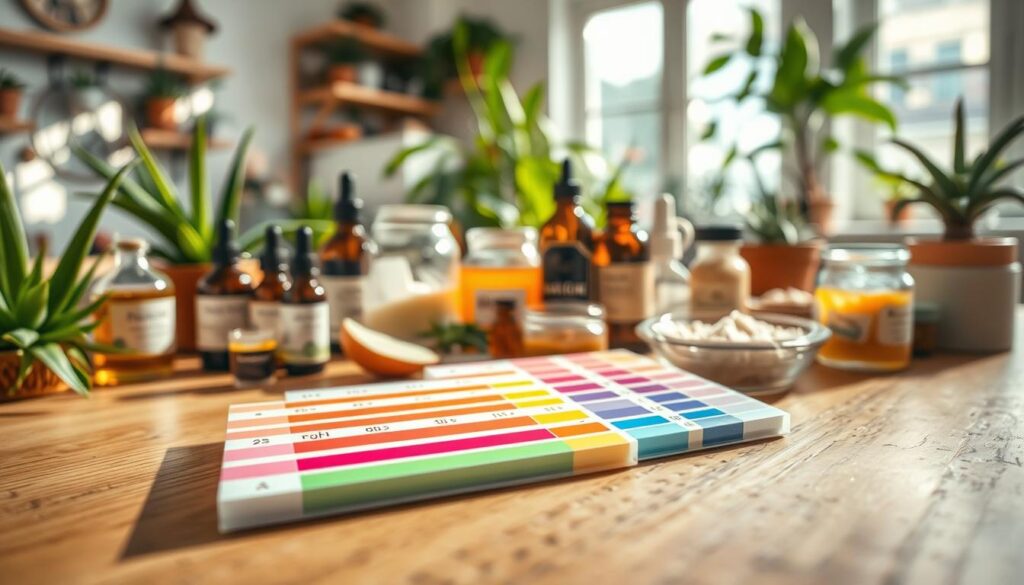
Why does this matter for natural cosmetics safety? Think of your skin’s barrier as a sophisticated security system. The correct pH is the valid access code. An incorrect pH is like trying to hack your way in with a sledgehammer.
Here’s the golden rule most beginners miss: pH dictates everything. It controls whether your preservative actually works or just takes a paid vacation. It changes your product’s texture from silky to slimy. It can alter color and mute delicate botanical scents.
For lotions and creams, aim for that magic number: under pH 6. This slightly acidic range keeps your skin’s barrier happy and your preservatives effective. Venture above 6, and you’re rolling out the welcome mat for microbes.
The tools? Surprisingly simple and affordable. pH test strips are your new best friend. They’re the unsung heroes of DIY beauty, giving you instant feedback without requiring a chemistry degree.
What happens if you skip this step? Your beautifully preserved cream becomes a microbial nightclub. Your gentle toner transforms into a skin-stripping assault on the acid mantle. The preservative you carefully measured? It might be completely inactive outside its ideal pH range.
This is where true natural cosmetics safety separates itself from mere mixing. Anyone can blend oils and waters. The artisan understands the chemistry that makes those blends stable, effective, and skin-compatible. pH testing isn’t an optional advanced technique. It’s the baseline for ensuring your creations honor both chemistry and biology.
So before you decant that lovely lotion into its final jar, pause. Test the pH. Adjust with a drop of citric acid solution (to lower) or baking soda solution (to raise). This sixty-second step is the difference between a product that nurtures and one that potentially harms.
Remember: Your skin’s acid mantle doesn’t negotiate. It doesn’t care about your good intentions or beautiful packaging. It responds to chemical signals. Giving it the right pH isn’t just smart formulating—it’s speaking its language fluently. And in the world of safe natural cosmetics, fluency is everything.
Essential Oil Safety and Dilution Rates
Essential oils are like A-list celebrities. They can be amazing, but also cause problems. Lavender oil can calm you down, but its chemical, linalool, might irritate your skin. This is why you need to know about DIY skincare precautions.
The “100% pure” label is misleading. It sounds great, but doesn’t tell you about safety limits. For example, eugenol in clove oil is safe at 0.5%, but not at 5%. The right amount is key, as Paracelsus said centuries ago.
Don’t rely on measuring by drops. Droppers aren’t precise. Temperature, oil thickness, and your hand movement can change the amount. Use milliliter syringes or graduated pipettes for accurate mixing.
General dilution rates are a good start, but not enough. For healthy adult skin, use 1-2% essential oil. That’s about 6-12 drops per ounce of carrier oil. But, this rule doesn’t apply to everyone.
Some essential oils need extra care. Linalool and limonene, found in your skin, can be harmful in high concentrations. European rules set limits for a reason.
Remember, dilution is the application of wisdom, not the dilution of power. Even a small amount of rosemary or peppermint oil can have a big effect. Too much can cause irritation.
Being careful with essential oils makes your craft more than just mixing scents. It’s about precise alchemy. Carrier oils help deliver these powerful ingredients safely.
Before using essential oils, think carefully. Measure accurately and dilute wisely. This careful approach shows you’re serious about DIY skincare precautions. It’s about blending art and science in natural skincare.
Recognizing Allergic Reactions
Your skin is more than just a canvas for your DIY projects. It’s a complex defense system with its own warning signs. When it finds something it sees as a threat, it doesn’t just send a gentle warning. It sounds the alarm.
Irritation is when your skin says it’s uncomfortable with something. It’s a short-term issue. But an allergy is when your immune system decides to fight a specific substance forever. This is why some ingredients, like certain essential oils, can become a problem over time.
Let’s solve a medical mystery. There are two main types of reactions to watch for. First, contact urticaria is an immediate reaction, like a hive-like response. It shows up quickly, like your skin reacting right away.
Then there’s allergic contact dermatitis, a sneaky reaction. It shows up 24-72 hours later as an itchy, blistering rash. It’s your immune system’s way of saying, “We’ve got a problem.”
The FDA says cosmetics must be safe for most people. But what’s safe for one person might not be for another. Your own body’s needs are unique.
Common troublemakers in DIY projects include:
- Essential oils: Like citrus oils and spices like cinnamon or clove
- Natural preservatives: Such as grapefruit seed extract, which might have synthetic additives
- Botanical extracts: Like comfrey, arnica, or chamomile in some people
- Carrier oils: Nut-based oils for those with food allergies
To figure out if you’re allergic, start with a patch test. Keep a log of what you use and any reactions. Your skin’s feedback is key to your DIY skincare journey.
If you see signs of a true allergy, like itching that lasts more than 48 hours, stop using that ingredient. Your body is trying to tell you something. Ignoring it could be dangerous.
This isn’t about being scared. It’s about respecting your body’s signals. True homemade beauty safety means listening to your skin. Sometimes, the best thing you can do is stop.
Child and Pet Safety Considerations
Your bathroom is like a lab when you make your own beauty products. It’s important to keep it safe from kids and pets. Homemade serums are great for your skin, but not for curious kids or pets. They might see it as just another liquid to play with.
Children’s skin is thinner and more open than adults’. Their bodies are not ready to handle some ingredients. Even natural preservatives can be too strong for them. For example, Geogard ECT is not safe for kids under three because it has salicylic acid, like in aspirin.
I learned this the hard way with my sensitive child. A product thought to be gentle caused a reaction. It was a wake-up call: kids are not small adults.
Pets, like cats, are also at risk. They can’t break down some ingredients, like in essential oils. These oils can make cats sick.
Dogs are a bit safer but can also get sick from these oils. It’s best to keep them away from these products.
To keep your home safe, start with storage. Use child-proof caps on all products. Keep them out of reach, high up or in locked cabinets. Kids love to climb and explore.
Also, check the ingredients. Ask if they’re safe for everyone in your home. Some oils and preservatives are not safe for pets. If unsure, don’t use it.
This isn’t about giving up on making your own beauty products. It’s about making them safe for everyone. Your DIY creations should be safe for all, not just you.
Remember, the most important rule is to respect the differences in your home. What’s safe for you might not be for others. Plan, label, and store your products carefully. The goal is to keep everyone safe and happy.
When to Avoid DIY (Eyes, Wounds, etc.)
Every DIY journey needs a map with clear boundaries. Some areas are off-limits for good reasons.
The eye area is not for DIY experiments. It has delicate tissues and complex fluids. This is a key DIY skincare rule. The FDA also has strict rules here.
Sunscreen is a special case. It’s not just oils and zinc oxide. It needs advanced technology to work well. Buying sunscreen is smart, not a failure.
Wounds, severe burns, or chronic skin issues need a doctor. DIY treatments can lead to infections or make things worse.
The best DIY skincare rule is knowing when to stop. Some products are best left to labs, not kitchens. Your skin’s health is too important to risk. Invest in proven, professional products for these areas.