Grabbing a moisturizer from a crowded drugstore is like fast fashion for your bathroom. It’s a quick deal, not a real connection.
Imagine if your skincare had a story as exciting as a top drama. Welcome to the world of artisan skincare. Here, ‘artisan’ is more than just a buzzword. It’s a way of making things.
It means real people, not machines, make the magic happen. ‘Small-batch’ means each product is made in tiny amounts. This way, every jar gets special attention. It’s not mass production; it’s careful crafting.
It’s all about the difference between a small studio and a big factory. The feel, the ethics, and the thinking behind it all are what set it apart. Why choose something mass-produced when you can support a craft?
Brands like the innovative Canadian beauty brands show us the way. They show that making things with care and in small batches is the future, not just a trend.
Craft Production Process
If mass production is like a symphony orchestra, small-batch beauty is more like a jazz quartet. The first is strict and follows a set score for thousands of times. The second is flexible, adapting with each new batch of ingredients.
This isn’t just a metaphor. In mass production, quality checks often involve testing one item out of ten thousand. But in small-batch beauty, every batch is a test.
A craftsman knows their recipe by heart. They can tell if the shea butter is too thick or if the essential oils don’t mix right. This is the human touch versus the efficiency of machines.
Founders like Faith Appleton of FāTH Skincare call this scalable intentionality. “Small batch is scalable; it’s a matter of how you do it,” she says. It’s not about being against growth. It’s about being agile.
This approach rejects the idea of always wanting more. The small-batch beauty way values quality over quantity. It means less waste and fewer chemicals. No products go to waste, and the process itself is the best quality check.
So, what do you get when you buy small-batch beauty? You’re paying for the time and care that goes into each product. It’s not just skincare; it’s a statement against sameness.
Ingredient Quality
Ever tasted a store tomato versus a fresh heirloom from a farmer’s market? That’s the difference in artisan skincare. One is made for long shelf life, the other for flavor and freshness.
Big brands use ingredients that are always the same. They’re made to last long and look the same every time. But, this process often takes away the good stuff.
Artisan skincare is different. It uses natural ingredients like oils and clays in their true form. They work with nature’s changes, not against them.
Raw honey in artisan skincare is more than just sweet. It tells a story of what local bees found. Skincare makers can change recipes to match the best harvests, like winemakers do.
FāTH Skincare grows their own arnica and lavender. They control everything from the soil to when they harvest. This means their ingredients travel short distances, not long ones.
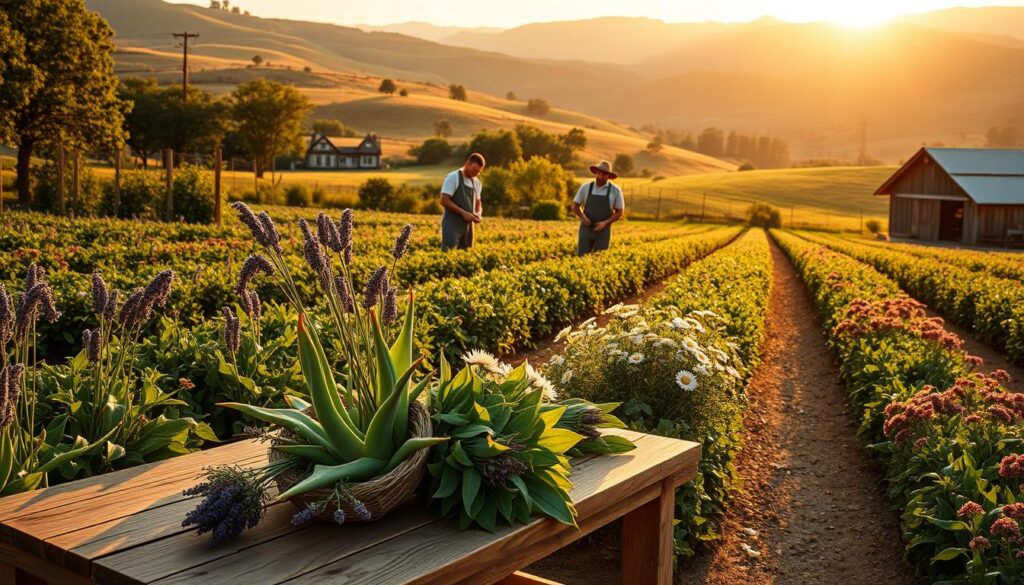
Then there’s Poetica, which focuses on regenerative farms. They don’t just buy ingredients; they invest in farms that heal the land. The quality of their ingredients is linked to the health of the land.
This isn’t just about being “all-natural.” It’s about integrity. It’s about knowing the story behind each ingredient. For those who care, understanding true ingredient transparency is key.
Artisan skincare uses gentle methods to keep ingredients fresh. They control the temperature carefully. This means the ingredients are full of life when they reach your skin.
So, the question is: which do you prefer on your skin? The processed ingredient or the fresh one? In small-batch skincare, it’s not just a choice; it’s the whole idea.
Supporting Local Makers
In today’s world of fast shopping, buying small-batch beauty is a bold choice. It’s more than just a purchase; it’s a vote for a different way of doing things. You’re supporting a craftsperson’s work, not just a big company’s profits.
Buying local is also good for the planet. A big brand’s failed product ends up in a landfill. But a small maker’s mistake is a chance to learn and grow. Plus, local products often use ingredients from nearby, so they’re fresher and better for you.

Shopping locally has a big impact on your community. Many people now choose to shop in their neighborhoods. This is because it feels good to know your money is helping someone in your area. Brands like To The Fairest in London focus on this personal touch, making each product unique.
Your support helps local makers buy from nearby farms and beekeepers. This keeps money in the community, helping other small businesses thrive. It’s a cycle of support and growth.
Buying from local makers means you get a product with a story and a face behind it. It’s the opposite of buying from big stores. When you support a local maker, you become part of their story. Your space becomes a collection of meaningful choices, not just products.
Case Studies on Best Brands
The proof is in the potion. Theory is elegant, but the real curriculum is taught by the brands on the ground. These case studies aren’t about faceless corporations; they’re about the artisan skincare sages who measure success in depth of impact, not just depth of wallet.
North of the border, Canada offers a quiet masterclass. It’s a scene less about flash and more about foundational integrity. Take Rocky Mountain Soap Company. Handcrafted in Canmore, it’s the industry’s tenured professor, proving longevity isn’t a fluke. Then there’s Graydon Skincare, which stuffs its formulas with superfoods like matcha and kale. It’s less a beauty routine and more a nutritional supplement for your face.
Wildcraft Skincare is the poster child for the hyper-local ideal. Their model is a closed loop: what’s around them is what goes in the jar. But the Canadian roster is deep. Refresh Botanicals brings clinical precision to plant power. Attitude Living makes non-toxic simplicity its entire brand ethos. Veriphy Skincare champions physician-developed, potent actives. Three Ships Beauty demystifies skincare with radical transparency. Each is a unique thesis on what small-batch can mean.
The plot thickens when you examine founders who don’t just source ingredients—they are the source. Poetica’s founder, Tess Albrecht-Schmitz, leveraged a master’s in Sustainable Supply Chains. Her brand connects scent to philanthropy. It’s supply chain as a story, not just a spreadsheet.
Then there’s FāTH Skincare. This is the farm-to-face movement literalized. The founder grows key actives on her own land. You’re not just applying a serum; you’re applying a piece of a specific, cared-for geography. It’s terroir for your complexion.
What about To The Fairest? It embodies the meticulous, small-batch alchemist. Each product feels like a limited edition, because it is. These operations aren’t built for a lightning-fast venture capital exit. They’re built on a slower, more potent fuel: conviction.
So, what’s the common lesson from these case studies? It’s that artisan skincare is a business model of authenticity. Rocky Mountain teaches consistency. Graydon teaches nutritional intelligence. Wildcraft teaches locality. Poetica teaches ethical narrative. FāTH teaches ultimate provenance.
They are the Sages of the industry. They educate not through marketing bullet points, but through example. Their success is a quiet rebuttal to the notion that bigger is always better. In a world of mass-produced sameness, they are the compelling, small-batch exception.
How to Discover Hidden Gems
The skincare aisle is full of marketing tricks. How can you tell the real artists from the big brands?
Start by being a detective. Look for batch numbers or production dates on labels. These are signs of small-batch beauty.
Artisans work in seasons. If a product is always available everywhere, it’s probably made in a factory.
Check the “Made in” line carefully. “Made in a family-owned lab in Owings Mills, Maryland” sounds real. “Made in a certified facility” doesn’t.
Ask about the farm, not just the ingredient. Real craft brands know their suppliers. If they can’t tell you, leave.
This search takes you off the beaten path. You’ll find hidden gems in boutiques, on websites, and at farmer’s markets.
Finding these gems takes effort. But the reward is products with stories, souls, and real effectiveness. That’s what small-batch beauty offers.