A compound linked to pomegranates and walnuts is attracting new attention in skincare after researchers reported improvements in wrinkles and cellular activity in a 2026 clinical study. Interest in urolithin A skincare benefits is growing, but the important question is whether those early findings justify adding another anti-aging product to your routine.
The evidence is more encouraging than a laboratory discovery alone. Yet proving that an ingredient influences aging-related processes is different from showing that it consistently delivers lasting improvements across different skin types.
Why Urolithin A Is Moving From Nutrition Research Into Skincare
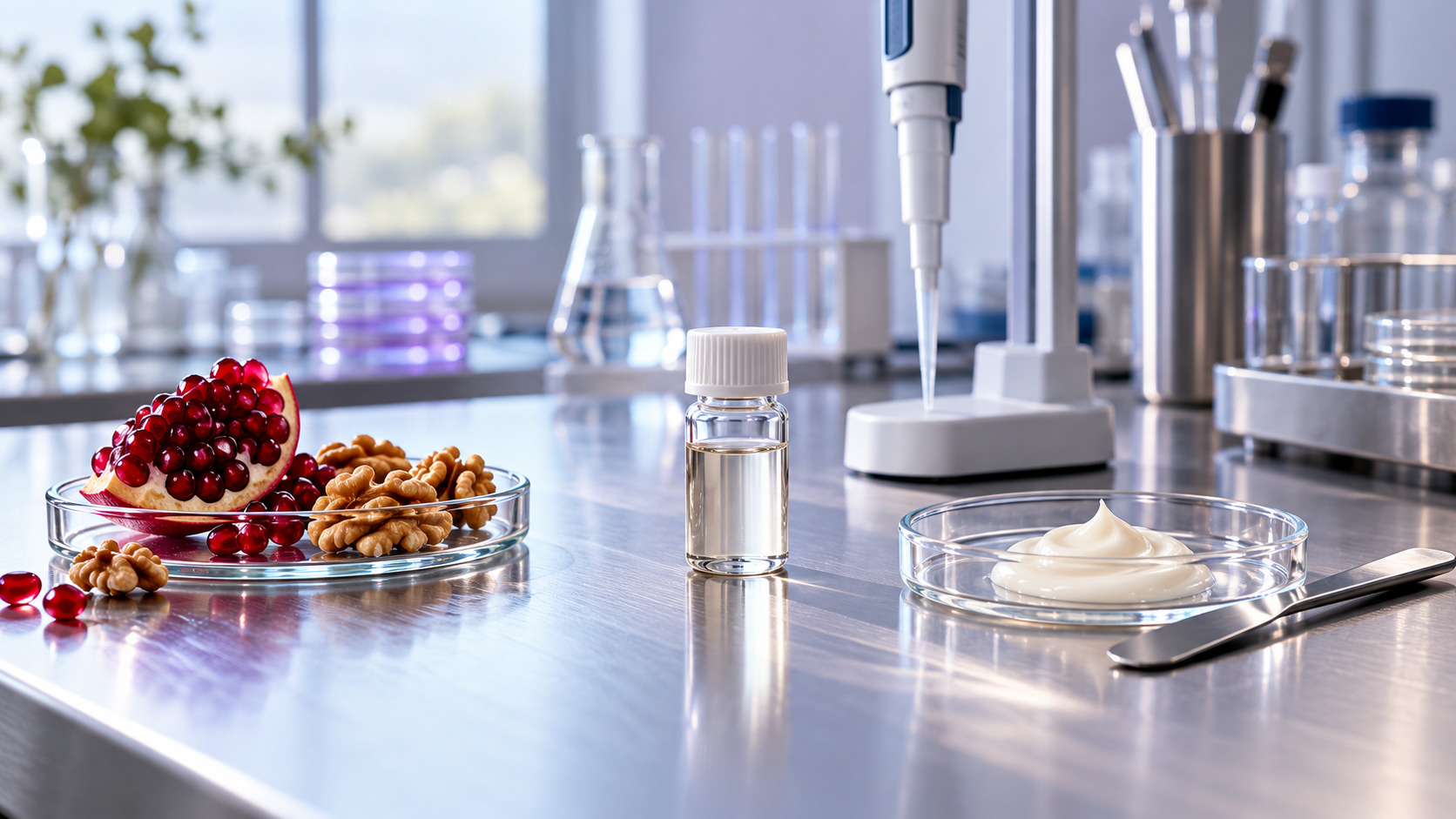
Urolithin A is a postbiotic compound produced when certain gut bacteria break down ellagitannins and ellagic acid, substances found in foods such as pomegranates, walnuts, and some berries.
The distinction matters because these foods do not directly supply substantial amounts of ready-made urolithin A. Its production depends on an individual’s gut microbiome, and not everyone produces the compound equally.
Researchers have studied urolithin A primarily for its potential effects on mitochondrial health. Mitochondria help cells produce energy, while also participating in processes that influence cellular stress and aging.
A scientific review of urolithin metabolism describes how gut bacteria transform dietary compounds into different urolithins and why production varies between individuals.
This background helps explain the ingredient’s appeal to skincare researchers.
Instead of focusing exclusively on surface moisture or exfoliation, scientists are investigating whether urolithin A can influence the cellular processes involved in maintaining healthy skin.
However, consuming pomegranates does not guarantee increased urolithin A production, and eating more of these foods has not been proven to reproduce the effects of a topical skincare formulation.
What the 2026 Study Reveals About Urolithin A Skincare Benefits
Research published in iScience in October 2026 examined topical urolithin A through laboratory experiments, reconstructed human skin models, human skin samples, and controlled clinical studies.
Scientists investigated whether the compound could improve mitochondrial activity, influence inflammatory signaling, and affect visible characteristics of aging skin.
The most interesting findings came from a randomized, placebo-controlled study involving 48 middle-aged women.
Participants applied formulations containing urolithin A or a comparison cream to different areas of their skin. Researchers measured visible wrinkles and examined biological changes after treatment.
After eight weeks, a cream containing 1% urolithin A produced a statistically significant improvement in wrinkle depth compared with the placebo formulation.
The lower 0.5% concentration did not demonstrate the same significant wrinkle benefit.
The 2026 clinical skincare findings also reported changes in cellular pathways associated with mitochondrial function, inflammation, and skin structure.
These results provide early human evidence of effectiveness, rather than relying entirely on theoretical mechanisms.
Still, the clinical trial was relatively small, lasted eight weeks, and involved a limited participant population. The research was also sponsored by a company with commercial interests in urolithin A.
These limitations do not invalidate the results, but they make independent replication particularly valuable.
How Mitochondrial Recycling Could Influence Skin Appearance
Much of the scientific interest centers on mitophagy, a process through which cells identify and recycle damaged mitochondria.
Healthy mitochondrial function supports the energy demands of skin cells. When mitochondrial quality control becomes less efficient, cellular stress may contribute to biological changes associated with aging.
Urolithin A has attracted attention because experiments suggest it can influence this recycling process.
In skin research, scientists have also observed changes involving proteins associated with collagen organization, epidermal development, and inflammatory signaling.
Collagen contributes to skin strength and structure, while the epidermis helps protect against environmental exposure and moisture loss.
These biological effects offer a plausible explanation for improvements observed in clinical testing.
However, cellular improvements are not identical to visible rejuvenation.
An increase in a biological marker does not automatically establish firmer skin, fewer wrinkles, or permanent repair.
Skin appearance also depends on genetics, ultraviolet exposure, hydration, sleep, smoking, and underlying skin conditions.
For consumers concerned about dryness or irritation, understanding how everyday habits affect dry skin remains useful alongside research into emerging ingredients.
How Urolithin A Compares With Established Skincare Ingredients
New ingredients often generate excitement because they target biological pathways that conventional products do not emphasize.
But a different mechanism does not necessarily mean a better result.
The following comparison separates the main purposes of familiar skincare ingredients from the emerging evidence surrounding urolithin A.
| Ingredient | Main skincare purpose | Evidence position |
|---|---|---|
| Urolithin A | Supports cellular pathways associated with skin aging | Promising early human trials; larger independent studies needed |
| Retinoids | Improve signs of photoaging and support skin renewal | Substantial clinical evidence, particularly for certain prescription retinoids |
| Hyaluronic acid | Improves skin hydration | Established moisturizing benefits; results depend on formulation |
| Ceramides | Support the skin’s protective barrier | Established role in barrier function and moisture retention |
| Vitamin C | Provides antioxidant activity and may improve uneven tone | Supportive evidence, with results varying by formulation and stability |
The comparison reveals an important distinction: newer does not mean superior.
Retinoids already have substantial evidence supporting improvements in certain signs of photoaging, although irritation can limit their use.
Moisturizers containing ceramides or other barrier-supporting ingredients address different concerns, including dryness and moisture loss.
Urolithin A may eventually complement these ingredients, but current evidence does not establish that it can replace them.
Its effectiveness within combination products also requires evaluation rather than assumption.
The Evidence Gaps Skincare Brands Must Address Next
The next stage of research should determine whether early benefits remain meaningful under ordinary consumer conditions.
Larger clinical trials involving different ages, skin tones, skin types, and sensitivity levels would help researchers understand who might benefit most.
Longer follow-up periods are equally important. An eight-week improvement cannot establish whether benefits continue after several months or disappear when treatment stops.
Researchers must also determine which concentrations and formulations provide reliable results without unnecessary irritation.
Another concern involves translating laboratory findings into marketing language.
A product claiming to support mitochondrial function should not automatically advertise permanent wrinkle removal or reversal of biological aging.
Even the reported reduction in UV-induced redness does not establish that urolithin A prevents sun damage or provides sunscreen protection.
For shoppers, formulation-specific evidence matters most. A clinical result involving one tested cream cannot automatically validate every serum, moisturizer, or supplement containing the same ingredient.
Safety testing is encouraging, but people with sensitive skin should still introduce unfamiliar products cautiously.
What Urolithin A Means for Natural Skincare in 2026
Urolithin A represents a promising direction in skincare research because its potential effects extend beyond temporary surface hydration.
The strongest development is the appearance of controlled human evidence connecting topical application with measurable improvements in wrinkle depth.
However, the research remains early, and broader independent trials are necessary before the ingredient can be considered a proven alternative to established anti-aging treatments.
Consumers do not need to abandon effective routines while waiting for those answers. Consistent moisturizing, appropriate sun protection, and evidence-based treatments remain practical foundations for healthy-looking skin.
As interest in urolithin A skincare benefits continues through 2026, the decisive question is whether future studies can reproduce meaningful improvements across diverse users and real-world products.
That evidence—not the ingredient’s natural origins or its connection to cellular longevity—will determine whether urolithin A becomes a lasting skincare innovation.